Welcome to our monthly newsletter THE GRACE NOTES, where we bring you tips and inspiration to help you create a more organized, harmonious living space. This month, we’re diving into the transformative power of the home organization process and how it can enhance your daily life.
As we embrace a new month, let’s focus on the power of a well-organized home.
Here are some impactful tips to help you transform your space:
Step-by-Step Tips for a Clutter-Free Space
Start Small, Think Big: Begin with one room or even a single drawer. Decluttering in manageable chunks prevents overwhelm and fuels motivation.
Declutter with Purpose: Assess each item’s value. If it doesn’t serve a purpose or spark joy, it’s time to let it go. Donate or recycle to reduce waste.
Create Functional Zones: Designate specific areas for different activities—cooking, working, and relaxing. This makes everything easier to find and use.
Maximize Vertical Space: Use shelves, hooks, and cabinets to utilize wall space. This keeps surfaces clear and the room feeling more open.
Regular Maintenance: Set aside 15 minutes a day for a quick tidy-up. Consistent maintenance prevents clutter from accumulating.
Personalize Your Space: Make your home uniquely yours. Incorporate items that reflect your style and personality, while maintaining a clutter-free environment.
A well-organized home not only looks great but also boosts your mental clarity and productivity. Start your journey today and feel the transformative impact of an organized living space.
If the thought of organizing your entire home feels overwhelming, remember you don’t have to do it alone. As a professional organizer, I am here to help you every step of the way. Together, we can create a customized plan that suits your lifestyle and transforms your home into a space where you can thrive.
Why Organize?
A well-organized home is more than just aesthetically pleasing—it’s a catalyst for a healthier, more productive lifestyle. Clutter and chaos can lead to stress, reduce your efficiency, and even affect your mental health. On the flip side, an organized home can create a sense of calm, improve your focus, and give you more time to enjoy the things you love.
The Benefits You’ll Experience
Reduced Stress: A tidy environment can help lower anxiety levels, making your home a true sanctuary.
Increased Productivity: With everything in its place, you’ll spend less time searching for things and more time being productive or relaxing.
Enhanced Creativity: An organized space can inspire new ideas and creative thinking.
Improved Health: Less clutter means fewer places for dust and allergens to accumulate, contributing to better indoor air quality.
Get Started Today
If the thought of organizing your entire home feels overwhelming, remember you don’t have to do it alone. As a professional organizer, I am here to help you every step of the way. Together, we can create a customized plan that suits your lifestyle and transforms your home into a space where you can thrive.
Ready to take the first step towards a more organized life? Contact me today to schedule a consultation and discover how we can bring order and tranquility to your home. Let’s make your dream space a reality!
USE A TIMER TO AVOID DISTRACTIONS – NOT THE ONE ON YOUR PHONE (optional)
1. Set a Goal for Your Closet (5 minutes)
Purpose: Determine how you want your closet to function as a place for coats, shoes, bags, or cleaning supplies.
Activity: Write down your main goal for the space and the key items that belong there.
2. Clear Out the Closet (10 minutes)
Purpose: Create a clean slate by emptying everything from the closet.
Activity: Remove all items, then clean the space. Dust, sweep, and wipe down the shelves and floor.
3. Sort and Categorize (10-15 minutes)
Purpose: Group similar items together to understand what you have and what’s worth keeping.
Activity: Use categories like Coats/Jackets, Shoes/Boots, Bags, Cleaning Supplies, etc.
Tip: Immediately create piles for Keep, Donate, and Trash to declutter.
4. Choose Organizational Tools (5-10 minutes)
Purpose: Maximize the closet’s functionality using storage solutions.
Suggested Tools:
Hooks or wall-mounted racks for bags, hats, or scarves.
Shoe racks or bins for footwear.
Shelving or baskets for seasonal items like gloves and umbrellas.
Over-the-door organizers for smaller accessories.
5. Return Items to the Closet (5-10 minutes)
Purpose: Arrange everything back into the closet in an organized way. EVERYTHING NEEDS A HOME!
Tip: Place most-used items at eye level and seasonal or rarely used items higher up.
Activity: Strategically put each item back, ensuring that the closet serves its purpose effectively.
6. Final Touches and Maintenance Plan (5 minutes)
Purpose: Make sure the space is easy to maintain in the long term.
>>POST A LIST ON THE INSIDE DOOR OF WHAT BELONGS IN THE SPACE- For younger kids, use pictures<<
Tip: Create a simple maintenance plan, like a quick 5-minute monthly declutter.
Activity: Label shelves or bins if necessary to keep the system intact.
Key Takeaway:
The entry hall closet is often a catch-all space, but it can transform into a functional, stress-free area with proper organization. Consistent decluttering and intentional storage will keep it organized.
As I approach the final stage of my current home office organization project—returning items to their newly organized homes—I find myself asking clients at this point of the project a crucial question: Are they still satisfied with the color scheme of their space? In this recent case, my client expressed dissatisfaction with the existing color, prompting us to explore options within my Sherwin-Williams COLOR tote box. The client has appreciated my brief guide to the meanings of colors, which inspired me to share it with you today.
The Meaning of Colors
How do colors affect moods? While perceptions of color are somewhat subjective, some effects have universal meaning. Colors in the red area of the spectrum can be yellow-based such as scarlet red and red-orange are known as warm colors.
These warm colors evoke emotions ranging from feelings of comfort and warmth to feelings of hostility and anger. Reds can also have an undertone of blue and are known as cool colors such as burgundy, ruby, raspberry, and deep cherry. These colors are often described as calm but can also call to mind seriousness and dignity.
The subject is well documented, so we’ll take a look at some personal and professional connotations associated with six of the rainbow colors to give you a better understanding of the psychology of colors.
1. Red
Red attracts the most attention and is associated with strong emotions, such as love, passion, and anger.
It’s the universal color to signify strength, power, courage, and danger. Red is vibrant, stimulating, and exciting with a strong link to sexuality and increased appetites.
Red is energizing and exciting, motivating us to act. It can also give confidence to those who are shy or lacking in willpower.
It’s warm and positive, generally associated with our most physical needs and our will to survive. It exudes a strong masculine energy. It enhances metabolism, increases respiration rate, and raises blood pressure.
Wear red to energize the group or the meeting but in smaller patches of the outfit, such as a blouse or scarf. It also does wonders to uplift your mood in a dark green, grey, black, and navy basic ensemble. Red ties are also favored by politicians as part of the red and blue tie partnership they wear with everything.
A little can go a long way, however, and in large areas red can cause visual strain. Wearing it too much, too often can brand you as a person in charge, but also as a bossy person!
2. Orange
This is the hue of encouragement, optimism, and self-confidence, marking the extrovert. Orange radiates warmth and happiness, combining the physical energy and stimulation of red with the cheerfulness of yellow. Orange can inspire courage, enthusiasm, rejuvenation, and vitality. It can also have a stimulating effect, particularly on the appetite.
It can also be a sign of pessimism and superficiality.
In business applications, orange gives the impression of affordability, depending on the shade chosen and its combination with other colors. More gentle than red, orange represents more feminine energy and the energy of creation.
For networking or a business social gathering, wear it boldly in a blazer. Pair it with a coordinating multi-colored top and solid slacks, or more cautiously in small patches in a printed top or scarf. It also combines naturally and beautifully with the Autumn shades of the Northern US taking on an artistic or grounded feel with brown and spicy shades. The downside of wearing orange is that orange dye lots vary in quality.
Be sure to check your orange purchase in daylight as the harsher light can downgrade the tone. Orange ties for men are still on the power list so wear them in an expensive silk foulard so that the colors gleam and radiate success.
3. Yellow
Yellow is the color of the mind and the intellect, resonating with the left, logical side of the brain. It is creative, the tone of new ideas and new ways of doing things. Post-it notes and legal pads were invented in yellow for a very good reason!
Being the lightest hue of the spectrum, yellow is uplifting and illuminating, offering hope, happiness, and fun. It’s a warm and happy color that creates a sense of cheerfulness and playfulness, brightening people’s spirits.
However, too much yellow can cause anxiety, nervousness, apprehension, agitation, and confrontation, particularly in people who are already stressed. It can also suggest impatience, criticism, and cowardice, and motivate people to become overly critical, judgmental, and deceitful.
Avoid dressing in yellow when trying to influence men. They tend to see it as cheap and unsophisticated. However, it’s brilliant to help stand out from the crowd and can easily be paired with a moderating shade to add more authority such as mid-blue or forest green. Yellow ties have fallen from the power tie rack recently but can still be worn successfully in a yellow and blue foulard print or polka dot.
4. Green
Green is of nature, of balance and growth. It is restful and secure, symbolizing harmony, healing, and stability.
It also represents security and self-reliance. Darker greens relate to money, wealth, and prestige, while lighter greens relate to rebirth, growth, and freshness.
However, too much green can lead to feelings of envy, greed, jealousy, and selfishness.
In business, green is beneficial for anything to do with health and healing and promoting natural, safe, organic, and environmentally friendly products. Dark green is a good choice for money and financial websites.
Wear it safely and to your advantage at work, in sales presentations, asking for funding or a loan. On the lighter side of the green, turquoise and aqua are two of the most popular colors, like the darker teal, all made from varying amounts of blue and green. They remind one of sunlight on a blue sea, health, peace, and abundance. Use the colors in solids or prints as tops, blouses, and shells under pantsuits with camel, beige, and taupe as well as purple and charcoal. Men can wear teal ties to their advantage when they want to look approachable and authoritative.
5. Blue
Blue is the color of trust, serenity, and peace. It suggests loyalty and integrity as well as conservatism and predictability.
This has the opposite effect on the brain than red. It is calming, reducing tension and fear, slowing the pulse rate, and reducing appetite. While inspiring wisdom and higher ideals, it is sincere, reserved, and quiet. Being cool creates a sensation of space.
Because blue is the most universally favored color of all, it is the safest to use in business and airline uniforms. It relates to trust, honesty, and dependability, therefore helping to build customer loyalty. Blue works well for the corporate world and is often used in important meetings.
Wear it when interviewing, and meeting business professionals such as accountants, insurance companies, bankers, and other financial companies where trust and reliability are important.
The downfall of blue and especially navy is that it can seem mature, conservative, boring, or denote a rigid outlook. However, many blues are more exciting than the navy. Think of a royal or a teal blue that is credible yet more interesting.
Royal blue ties are the politician’s uniform and are very predictable. Great for a conservative audience perhaps. Vary it a little with a blue or navy suit and white or pale blue shirts. What about a tie in varying shades of blue with a splash of red?
6. Purple
Purple is the color of imagination and spirituality, inspiring high ideals. It can be creative and individual or immature and impractical. It is also an introspective tone, allowing us to connect with our deeper thoughts.
People drawn to purple are usually sensitive, understanding, and supportive, thinking of others before themselves. They will often have a peaceful and tranquil quality, with quiet dignity about them.
Purple implies wealth, even royalty, as well as quality, fantasy, and creativity. This tone heightens people’s sense of beauty and their reaction to more creative ideas.
It is often used to denote a high-quality or superior product. If you are in a service business, use some purple in your marketing to promote your premium service.
On your next shopping trip look for purple which is a much more creative choice than buying another black jacket. It’s a good substitute for red and goes well with most pastels to give a high-contrast look of authority, without resorting to the black and white cliché.
Wear it with the confidence that you are going to look expensive and creative. Purple ties and pastel mauve or pinstripe shirts for men are often favored by the more adventurous, creative dressers. Wear them with confidence if you are representing a creative industry, service, or product.
Are you still happy with the colors in your space?
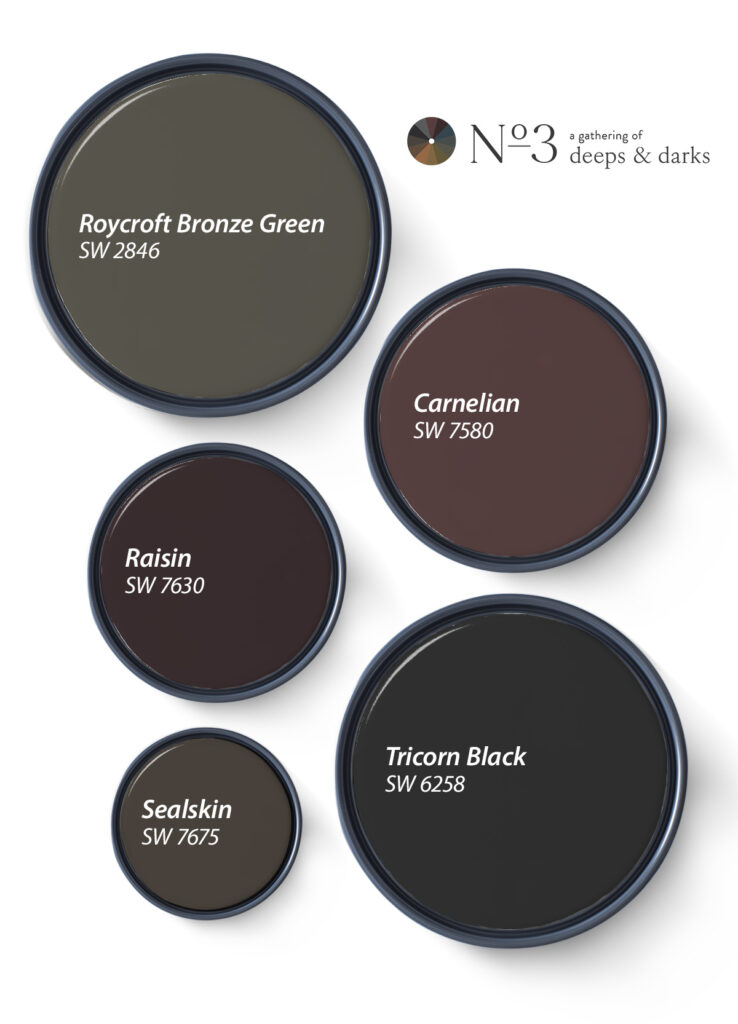
Dark paint colors are not only incredibly stylish but also versatile, exuding a moody atmosphere that can instantly evoke a cozy and calming effect. We’re highlighting five of our favorite hues from A Gathering of Deeps & Darks palette in our 2024 Colormix® Forecast that will undoubtedly boost your confidence in exploring the darker side of the color wheel.
Roycroft Bronze Green SW 2846: This historic, deep forest green hue brings a vintage feel to spaces and is stunning either as an accent or drenching an entire space. Roycroft Bronze Green’s grounded, earthy tone instills a sense of tranquility, effortlessly creating harmonious, nature-inspired spaces.
Carnelian SW 7580:Carnelian’s deeply saturated burgundy hue inspires an intriguing aura of mystery. It’s the perfect shade for going dark without diving all the way into the depths of an inky black.
Raisin SW 7630: Looking for a little drama? Raisin’s rich, dark brown hue adds a captivating allure to any space. This chameleon shade’s purple undertone lends it an easy versatility that can lean either warm or cool depending on surrounding tones and lighting.
Sealskin SW 7675:Sealskin has a refined, deep tone that creates a contented, cocoon-like atmosphere. This bold shade easily wraps spaces in luxurious, inviting warmth and adds nuanced sophistication. Moody enough to inspire quiet reflection yet classic enough to feel elegant.
Tricorn Black SW 6258: A long-standing fan favorite, Tricorn Black is one of our deepest, truest blacks. With virtually no undertones, this timeless neutral shade is supremely versatile, effortlessly pairing with any material, tone, or texture.
Explore the full collection of shades in the A Gathering of Deeps & Darks palette in Anthology: Volume One, our Colormix ® Forecast for 2024.Want to see these hues in your space? Get FREE color chips for the whole palette, and if you need help choosing, book a FREE Virtual Color Consultation for personalized, one-on-one guidance with one of our experts.
**A personal note: I am usually pleased with the colors chosen by Sherwin Williams, this color was not a favorite of mine, but when you POP it with some color . . . it did change my mindset about the color. Pair up SW6605 Charisma with the SW7580 Carnelian . . . Gorgeous!
I might be going against the grain here, but I don’t talk about streamlining until my clients have lived in their newly organized space for a bit. I tell them to try sitting in a different spot than usual, like a different chair or part of the couch. They’ll get a new perspective on their space and might be surprised at how adaptable humans are in their environments.
Now, the fun part starts! Labeling, totes, storage containers… People think that the fun part of organizing is all the pretty stuff. Trust me, I’ve broken many hearts with clients who thought this way on our very first day. But after going through the process, they understand that patience and consistency are what get you to that calm living.
Streamlining a space that has already been organized involves maintaining order and optimizing the efficiency of the existing organizational system.
Here are some steps to help you streamline a space:
Assessment:
Begin by evaluating the current state of the space. Identify any areas that may have become cluttered or disorganized since the initial organization.
Declutter:
Remove any items that do not belong in the space or are no longer needed. Be ruthless in decluttering to maintain a clean and organized environment.
Reevaluate Storage Solutions:
Assess the effectiveness of the storage solutions in place. Consider whether there is a need for additional storage or if the existing storage can be optimized for better use of space.
Labeling:
If items are not already labeled, consider adding labels to containers, shelves, or drawers. Clear labeling makes it easier to locate items and encourages everyone to return items to their designated places.
Routine Maintenance:
Establish a regular maintenance routine. Dedicate a few minutes each day or week to tidying up the space, putting things back in their designated spots, and addressing any emerging organizational issues.
Optimize Layout:
Consider the flow and arrangement of items in the space. Optimize the layout to make it more intuitive and efficient. Frequently used items should be easily accessible, while those used less frequently can be stored in less accessible areas.
Digital Organization:
If the space involves digital files or equipment, organize digital assets and folders. Delete unnecessary files and create a logical folder structure. Ensure that electronic devices and cables are organized and tidy.
Create Zones:
Group similar items together to create functional zones. This makes it easier to find things and promotes a more organized look. For example, create a work zone, a storage zone, and a relaxation zone in a multipurpose room.
Implement Systems:
Establish systems for handling incoming items. Whether it’s mail, supplies, or other items, having a clear process for dealing with new items prevents them from piling up and disrupting the organization.
Evaluate and Adjust:
Regularly assess the effectiveness of the organizational system. If certain areas still tend to become disorganized, consider adjusting the system to better suit the needs of the space and its users.
Involve Others:
If the space is shared, involve others in the organization process. Establish guidelines for maintaining the order, and encourage everyone to contribute to the streamlined environment.
Remember that organization is an ongoing process, and regularly revisiting and maintaining your systems will help keep the space streamlined over the long term.
What does it mean to be organized? This is a question I get from my clients, especially when they are in the INTENTIONAL DECISION process of the Organize Coaching program. It is not an easy question to answer, because I know what it is like for me – we are all different when it comes to finding “homes” for our belongings.
Being organized means different things to different people. For some, it means having a clean and tidy home. For others, it means being able to find what they need when they need it. And for still others, it means being able to manage their time effectively.
There is no one right way to be organized. The important thing is to find what works for you and stick with it. If you are struggling to get organized, there are many resources available to help you.
The most important thing to remember is that being organized is a journey, not a destination. It takes time and effort to get organized, but it is worth it in the end. When you are organized, you will feel more in control of your life and you will be able to focus on the things that are important to you.
Being organized can have various meanings and interpretations depending on the context and individual perspectives. Here are some common characteristics and experiences associated with being organized:
Clarity and Focus: Being organized often entails having a clear understanding of priorities, tasks, and goals. It involves being able to focus on what matters most without getting overwhelmed by unnecessary distractions or clutter.
Efficiency and Productivity: Organization often leads to increased efficiency and productivity. By having systems in place, being able to find what you need when you need them, and managing time effectively, you can accomplish tasks more efficiently and make better use of your resources.
Reduced Stress: An organized lifestyle can contribute to reduced stress levels. When you have a sense of control over your environment, tasks, and commitments, you are less likely to experience the anxiety and overwhelm that can come with disorganization.
Improved Time Management: Being organized allows for better time management. You can prioritize tasks, allocate time effectively, and create schedules or routines that optimize your productivity. This can help you avoid procrastination, meet deadlines, and have a better work-life balance.
Less Clutter and Physical Order: Organization often involves keeping physical spaces tidy and clutter-free. Having an organized living or working environment can create a sense of calm, make it easier to find things, and provide a visually appealing space that promotes well-being.
Better Decision-Making: Being organized can contribute to better decision-making processes. When you have a clear overview of your options, relevant information, and priorities, you can make informed choices more efficiently and confidently.
Improved Accountability and Responsibility: Being organized can foster a sense of accountability and responsibility for your actions and commitments. By having systems in place, tracking progress, and meeting deadlines, you can develop a reputation for reliability and dependability.
Enhanced Creativity and Focus: Some individuals find that being organized can enhance their creativity and focus. When the external environment is organized and distractions are minimized, it becomes easier to concentrate, think creatively, and generate new ideas.
It’s important to note that being organized is a personal journey, and what works for one person may not work for another. The key is to find organizational strategies and systems that align with your preferences, needs, and goals, and create a sense of order and harmony in your life – this is where a Professional Organizer Coach can help you.
𝓟𝓮𝓪𝓬𝓮 & 𝓗𝓪𝓻𝓶𝓸𝓷𝔂 ~ Your Organizer & Coach, Cheryl
If you are seeking further guidance beyond this post, my personalized coaching programs may be of assistance to you. Please book a complimentary session to discuss what is holding you back. I look forward to guiding you on your journey to achieving organized spaces in your lifestyle.
NEW PHONE # 860-941-8630
A TEXT gets to me faster: Name, Issue, the Best time to call
Here’s how a Home Stager can get the premium price from a sale
Stagers are professionals who work with real estate agents to help them sell homes by enhancing interiors for the best possible presentation. Realtors know that selling is more effective, and perceived values increase when prospective customers walk through rooms that are beautifully designed and decorated. This is where the stager can be an essential partner to the agent and the seller.
We partner with real estate agents and Property Managers like yourself in order to market your listings to their best capacity. Partnering with a professional home stager & Redesigner adds credibility to your business, tremendous value to your listing package, and ultimately results in faster, more profitable home sales. Certified Home Stagers are specially trained to work with agents to quickly transform the inside of the home so that the traffic that the agent drives to the home will result in multiple offers.
How do they do this? We use an 8-step “FEEL HOME EMOTIONS” mission in each room of the home that serves to engage your clients (the home seller) in the process while ensuring that every detail is dealt with in the transformation of the home.
Here are the three easy steps to ensure a SOLD home:
1. Before listing the home, have a Home Stager come to the home and develop a plan for staging the home that focuses on quick transformations, return on investment and works within the client’s budget. Even if you’re a DIYer, we can create a WALK & TALK action plan for you to reference.
2. Working with the home seller, the Home Stager makes only those changes that will reap a large return on dollars spent AND will speak to home buyers’ emotions.
3. Once staged, the home is photo ready! Since 95% of home buyers are using the Internet to determine whether to visit the home, photos of professionally staged rooms will set the listing apart from the rest.
Staging of Owner-Occupied Homes for Sale –We offer a variety of services for occupied homes including in-home consultation, a DIY Walk & Talk action plan, art and accessory packages, and staging only a particular room to showcase its function. Occupied staging focuses on decluttering and furniture placement over purchase to make your home market & photo ready.
Staging of Vacant Homes for Sale –We walk every property before providing a bid so we can create a customized design plan that positions the home to sell fast, with the most abundant amount. Our bid is a fixed, flat fee – no monthly fees, no ongoing fees, no design fees, no delivery fees … NO Surprises! The rental fees are based on the number of rooms or square footage of the home.
Interior Redesign –Lifestyle by Design can provide options and ideas for “refreshing” your home’s decor as well as providing assistance with shopping (which is primary in-home shopping) and setup. Services and products can be customized to fit the homeowner’s budget. This service works well if you have an upcoming personal or business event that you’ll have within your home, great way to showcase your sanctuary.
Holiday and Event Staging – Whether you’re planning an event at your home or office and need assistance decorating for the holidays, Lifestyle by Design can provide options and ideas to give your space that perfect look to enhance that special occasion. Services and products can be customized to fit the homeowner/client’s budget.
It’s human nature to be attracted to pretty things and staged homes are much prettier than unstaged or badly staged homes. Staging relieves your client of stress and pressure and worries if their home looks good enough for buyers to pay the highest price.
Professional staging will encourage the buyer to form an ‘emotional link’ with the house and it’s that connection that leads them to buy the home. When our home was on the market I put out pamphlets of information about the local schools, local farmer markets, local wineries & Music – this way it makes them a part of home & community. It’s an idea I took from going up military, for each new deployment we would have a welcome kit waiting for us with all the information we needed to engage with our new community.
Remember staging is an investment, not an expense. You are investing in a proven method for appealing to the greatest number of potential buyers willing to pay the highest price. Remember earlier when I said we had our home on the market – it was on the market for 1 day, our home was a 30-year-old home with some aging, and it was bought within 4 hours. I asked our realtor what was her response to your survey question, and he said as she walked around she felt she had found “Home”.
If you’re looking for guidance beyond this post today, my Coach/Organize/Stage Programs can be customized just for you and/or your clients. Book a Complimentary Session to discuss how I can help your clients get the best and quickest price for their homes. I look forward to guiding you on your journey to achieve a ‘Showcase’ of your homes or business.
Ways to contact us!
Call/Text 860.961.6824 or you can email envisionsdesigns@gmail.com for your free 1/2 hour consultation.
In 1995, I found myself recleaning the same clutter in clients’ homes. I decided to ask a few clients that I was close to if I could apply my C – O – R + method in their homes.
I had “absolutely” from everyone. I sat with them explaining that while cleaning their homes, I had noticed that I can no longer fit one more bottle of cleaning products under the kitchen sink or fit one more pair of shoes into the hallway closet.
I explained my C – O- R + method: the acronyms stand for CLEAN – ORGANIZE – REDESIGN + so much more. I told them that I was noticing clutter in spaces where I kept recleaning and tidying up each week. I explained together we could come up with systems that can make the home functional, and efficient with purposeful spaces. I discussed how from then on when I clean their homes, I would organize drawers, cabinets, and closets along my path of cleaning.
When I finished my first home with my new method – it was celebrated by the family giving notes and cards when I arrived at their home the following week.
The notes mentioned items like Time Saving, Saving money at the grocery store because of no more overbuying, and finding paperwork for school or work easier, getting out of the door on time in the mornings.
After leaving that home with cards and notes in hand, I decided to make an intentional decision for my business that the Clean – Organize – Redesign method will become the foundation of my cleaning company.
I found a niche in the then-saturated cleaning business. It has served clients well over the last 27 years, In 1999 I brought the method into commercial cleaning, which lead to helping out small doctors’, and lawyers’ offices get organized and be more efficient businesses.
This new business foundation solved a problem for my clients, it fit the 3 priorities I found to make the final decision to interweave this method into my business.
I would leave my clients homework when they were having a hard time making those decisions, here is the homework I would leave them:
1-minute blueprint for making difficult decisions
What is the problem that needs to be solved? (declutter clients’ homes)
Identify your top priorities for having the problem solved (keep it to 3) (save client time, save labor, extra$)
List them in the order of importance (save client time, save labor, extra$)
Write the 3 priorities in their order, and post them where they’re visible
The next time they had to make a difficult decision, they could evaluate their options through what they learned is most important to them.
Below is a 10/10 sheet, ten spaces, ten minutes – these are spaces where you’re going to see quick visuals of organizing, it helps to keep you motivated for your next challenge.




 Lifestyle-by-designs